Rosa Bonheur and the Art of Watching Horses
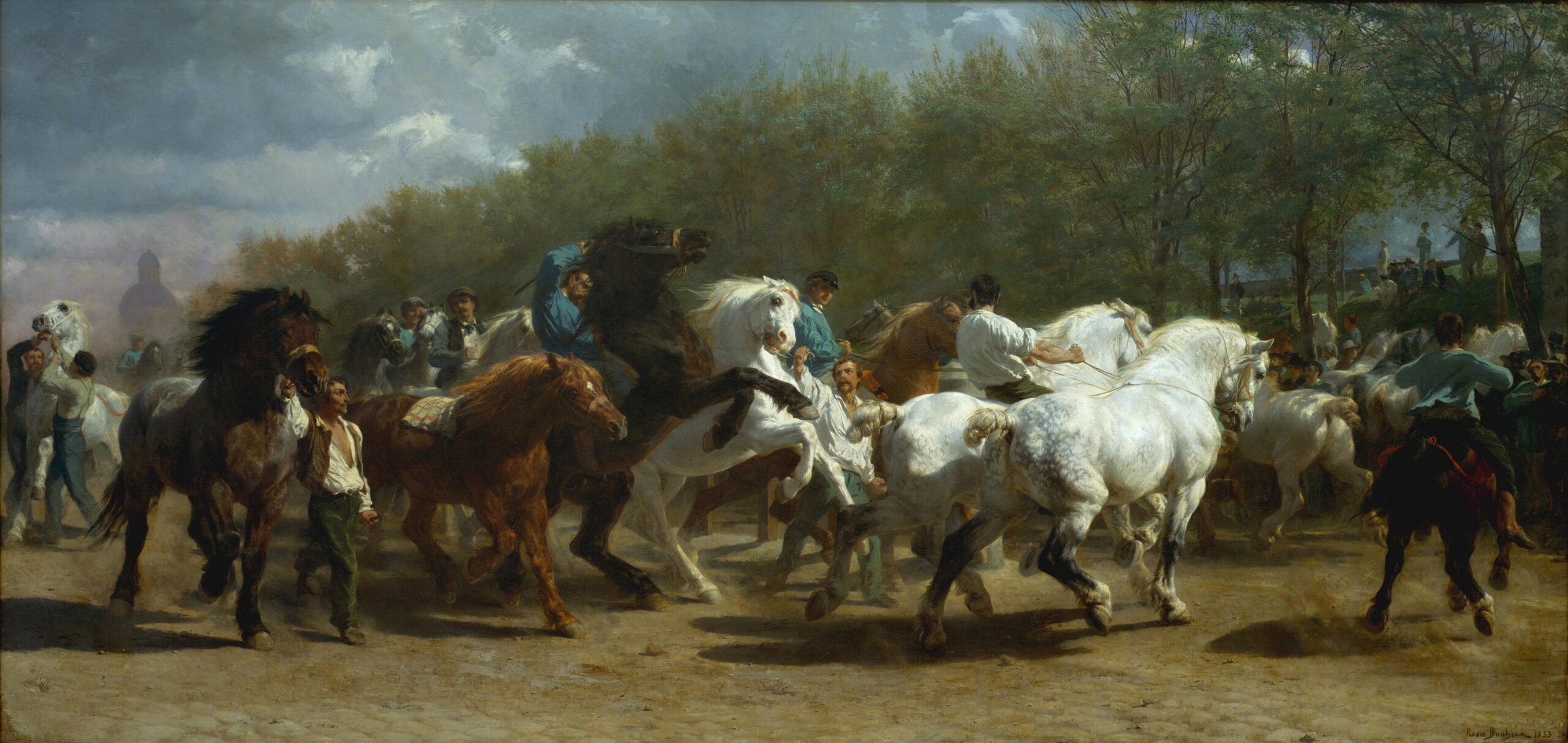
Oil on canvas. The Metropolitan Museum of Art, New York. Gift of Cornelius Vanderbilt, 1887.
White, black, and brown horses crowd a tree-lined Paris road. Two rear near the center as handlers guide the group past spectators on a grassy bank.
A quick sketch of the artist and her art
The people on the grassy bank in “The Horse Fair” picked a sensible spot. From their vantage pint, they can watch the horses pass by without worrying about getting stepped on. Artist Rosa Bonheur, though, puts the rest of us down at road level, where a dapple-gray horse swings across the foreground and a pair of raised hooves seems much too close.
Born Marie-Rosalie Bonheur in Bordeaux in 1822, Rosa trained with her father, the painter Raymond Bonheur, and practiced her skills by copying paintings at the Louvre. She first exhibited at the Paris Salon, France’s major public art exhibition, in 1841. A government commission led to “Ploughing in the Nivernais, a painting of working oxen that established her reputation at the 1849 Salon. Musée d’Orsay· National Museum of Women in the Arts.
To prepare “The Horse Fair”, Bonheur went to the horse market on Paris’s Boulevard de l’Hôpital twice a week for about eighteen months. She wore men’s clothes to draw less attention while she sketched. At the 1853 Salon, she presented a horse market on the scale of a grand history painting. The canvas, more than sixteen feet wide, drew praise at the exhibition. Bonheur retouched it in 1855. The Met]· Musée d’Orsa
Sales of paintings and prints helped Bonheur buy the Château de By, on the edge of the Fontainebleau forest. She moved there in 1860 with her longtime partner, Nathalie Micas, and Micas’s mother. Micas helped prepare canvases, and the horses, dogs, and other animals they kept and which gave Bonheur subjects to draw from life daily. Musée d’Orsay· Royal Collection Trust.
An unexpected visitor
On June 14, 1864, Bonheur was painting deer when she heard carriage wheels, bells, and cracking whips outside. As she later recalled to the painter Anna Klumpke, Micas rushed into the studio with a skirt and jacket. Empress Eugénie had arrived, and Bonheur had just enough time to change out of her work smock before greeting her. She showed the empress the deer painting still in progress. By the time Eugénie left, she had commissioned a painting for her own collection. Bonheur’s account, published by Anna Klumpke.
Eugénie returned the following year to pin the cross of the Legion of Honor on Bonheur, the first woman artist to receive the distinction. In 1894, five years before her death, Bonheur became the first woman promoted to officer in the order. Archives of the Legion of Honor.
Bonheur called “The Horse Fair” her own Parthenon frieze. Follow the horses from left to right and you can see what she meant. Their heads rise, dip, and rise again across the long canvas. Some hooves are planted while others hang in the air. The whole procession pulls your eye around the bend. The Met.
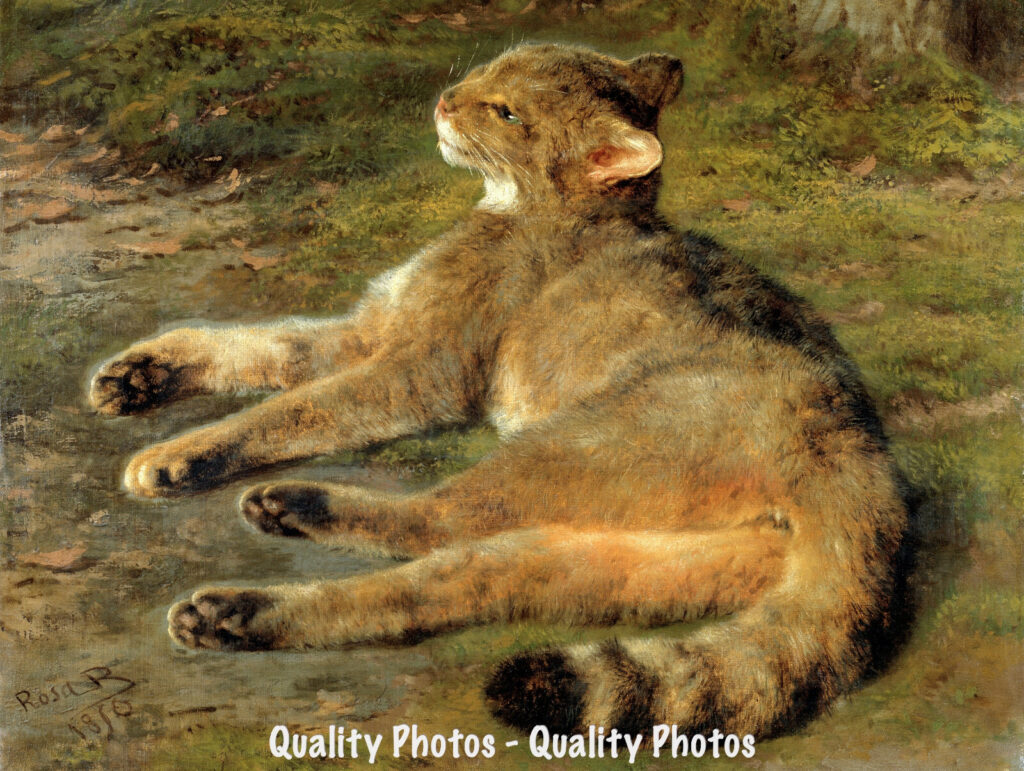
I first discovered Rosa Bonheur through her cat paintings. Below is one of my favorites by Bonheur…
 rode a horse in the wild countryside of the Rockies not far from Alamosa, Colorado, to go fishing – traveling to a hidden spot with my father and uncle and older brother Jon. By riding, I mean, sitting on the horse The fishing spot was a pond under dark trees My chance to redeem my horse experiences came, The stables did not give me a friendly horse, I snicked clicked from the side of my mouth, I did my traditional falling dismount, Horses cost me, in my early childhood, ©2026 Carl Scott Harker, publisher of  Western Love Western Magic |