By: Eartha Linda
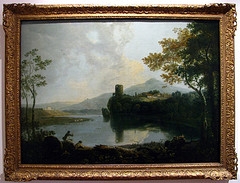
Richard Wilson was the foremost artist of the great English Landscape Painters. His grand, brooding landscapes, greatly encouraged and influenced the works of William Turner and John Constable.
Adolescence and Art Training:
Richard Wilson was born on August 1, 1714 in Penegoes, Montgomeryshire in North Wales. His father was a Rector and the family background was very high class. They were linked with some of the finest characters in 'Local High Society.' One such example was the very wealthy and highly effective Sir George Wynne, Wilson's maternal uncle, who noticed his nephew's artistic talent and encouraged it.
In 1730, Uncle George sent Wilson to London to be apprenticed for six years with a leading painter of the time, Thomas Wright.
Early Profession:
For many years, young Richard Wilson remained dependent on his Uncle's generosity and gained more of a notoriety as a fashionable young man about town rather than as a painter. But in the 1740s, he knuckled down to the intense business of the fine art creation and gained several necessary patrons.
The most crucial of these was the socially and politically distinguished Lyttleton Household, many members of which commissioned portraits from Wilson. His rising success as a Society Portrait Painter enabled Wilson to moved to a bigger, extra snug studio on the very fashionable Covent Backyard Piazza.
Grand Tour:
In 1750, with the financial backing of his buddy Commodore Thomas Smith, the son of Sir Thomas Lyttleton, Wilson launched began the mandatory 'Grand Tour.' As an English gentleman and artist, to promote yourself, it was necessary to travel the European Continent, and especially tour Italy.
Your cultural schooling was not finished until you could walk into your Club and announce loftily, "Sure, I had coffee at the Cafe degli Inglesi in the Piazza di Spagna. Then we did the ruins. They have been so inspiring. You don't get ruins like these any more. Although, the other day I had a premonition that we'll build trendier versions in the very distant future."
After crossing the Channel, Wilson went to Venice and remained there for several months, studying the works of Titian and different Old Masters. He continued working as a Portrait Painter.
He befriended a leading Venetian Landscape Painter, Francesco Zuccarelli, and a rich, painting-loving Englishman, William Lock. Wilson painted a portrait of Zuccarelli and took seriously his advise to focus on landscapes. William Lock bought his paintings and invited him to travel with him. At the beginning of 1751, Wilson left Venice traveling through various notable towns of Italy before reaching the grand city of Rome.
Wilson stayed in Rome until 1757. As was his wont, he chose to settle in the most trendy location on the town - the Piazza di Spagna. This area was a magnet for artists, foreign and native alike. It was where English tourists gathered who were eager to purchase works showing the Roman countryside and monuments and provide many artssts with a very respectable income.
Seeing the demand, Wilson decided to take up oil landscape painting within the classical model with a vengeance. He was inspired by the works of Poussin and Claude Lorraine, as well as that of contemporary painters like Vernet and Mengs.
Along with William Lock, he gained other important patrons like Ralph Howard, Viscount Wicklow, and William Legge, Earl of Darmouth, and the Earl of Leicester, and Cardinal Albani. For William Legge, he produced a quite remarkable sequence of chalk drawings of the Palatine Hill.
Back in England:
Upon his return to England, Wilson set up a grander studio than the one he had left, participated in the founding of the Society of Artists, held many exhibitions, gained a substantial fame, and offered works to an ever growing number of famous patrons at stupendous rates. Success, it appeared, was here to stay.
But with all the money and adulation, Wilson grew smug to the point of rudeness - there's a famous story about him telling King George III, that it would be quite okay for His Majesty to pay in weekly installments, when the King thought that 100 guineas per oil painting was simply too bloody much. Oops...
The King and Wilson's former patrons, miffed by his condescending attitude, turned their attention to different artists like the Irish George Barret and Wilson's old friend, Zuccarelli.
Towards The End:
With little work now coming to him, Wilson took to drinking in an enormous amounts which led to one long slide into poverty and ill-health. When his friends' efforts failed to save either his health or profession, he was taken again to the family house in Wales. He died right here on May 15, 1782.
Some Famous Works: 'Snowdon from Llyn Nantlle', Walker Gallery art painting Gallery, Liverpool; 'Cader Idris', Llyn-y-Cau', Tate Gallery, London. and 'Llyn Peris and Dolbadarn Fortress', National Gallery of Victoria, Melbourne.
Author Resource:-> Check out the gallery of painting here. ---- Article From Articles For All
British painter Richard Wilson - artnet Magazine
William Bond Portrait of Richard Wilson, Landscape Painter After Anton Raphael Mengs "Richard Wilson and the British Arcadia" Richard L. Feigen & Co. Richard Wilson Caernarvon Castle ca. 1744-45. Detroit Institute of Arts ...
Publish Date: 06/25/2010 0:00
http://www.artnet.com/magazineus/reviews/karlins/richard-wilson6-10-10.asp
Art: Tom Jones | WALDEMAR JANUSZCZAK
His folks paid for him to study in London under the other Welsh landscape painter of note, Richard Wilson, a “gentleman painter” too, and it was from Wilson that Jones inherited most of his landscape tricks, tics and ambitions. ...
Publish Date: 11/16/2003 3:57
http://www.waldemar.tv/2003/11/art-tom-jones/
New Modern and Contemporary Art Galleries Complete Wales's ...
The largest of these, Art in eighteenth century Britain , features the Welsh-born painter Richard Wilson and the magnificent art collections of Sir Watkin Williams-Wynn, as well as the impact of the European Grand Tour and the ...
Publish Date: 04/17/2011 21:37
http://www.artdaily.com/index.asp?int_sec=11&int_new=46633&int_modo=1
As in all of art, the art of watercoloring has amassed a collection of techniques that have been painstakingly discovered over the years. Artists have tried a myriad different ways to create the desired effect on canvas and paper. The most useful techniques have survived the test of time becoming part of the artist's technical tool chest and are in use today.
The following are some methods in vogue today in the beautiful art of watercolor painting.
Washes
The first technique on the list is the most basic of them all, washes... For example, the flat wash. One way of doing it is wetting the area on the paper and mixing enough pigment to fill it up.
The graded wash requires that the pigment is slightly diluted with water with each stroke. The resultant wash fades out gradually and evenly.
Glazing
This is almost the same technique as a wash, except that it uses a thin, transparent pigment applied over dry existing washes. This is mainly to adjust the color and tone of the underlying wash.
The trick to success is to make sure the first wash to be painted over is dry.
Wet in Wet
Wet in wet is applying the pigment to a wet paper. Depending on the wetness of the paper, the resulting strokes can vary even from each other. It can leave soft undefined shapes or some slightly blurred marks.
This technique is applied over existing washes. You just have to make sure the laid-on washes are dry.
Simply wet the paper with a large brush and paint into the dampness. Those marks made by, wet in wet, make very subtle background regions in the painting.
Dry Brush
This is almost the opposite of the wet and wet technique. The brush filled with a pigment and then slightly dipped in water is dragged on a dry paper.
The marks produced by the strokes tend to come forward and are crisp and hard-edged. They are best applied around the focus of interest in the painting.
Lifting Off
To lift off color and pigment from the artwork, wet the area with a brush and clean water and blot the pigment away with a tissue. Masking some areas of pigment with strips of paper in the lifting process will bring out some interesting hard-edged lines and shapes.
(Some pigments are difficult to remove and should be avoided in this technique - Prussian blue, Windsor red, yellow and blue.)
Dropping in Color
For some surprising effects, try this technique. The process is simple. Introduce a color into a wet region and let it bleed, blend, and feather without interruption.
The resulting shapes and forms are unpredictable and interesting, and can be astonishing, at times. This is one color gradation that cannot be achieved by mixing the pigment on the palette.
Splattering
For certain needs of the painting, splattering paint can be done to achieve what you want.
First, dip a brush (or a toothbrush, depending on the size of spatter you want) into the paint. Scrape the bristles with a finger from your other hand and aim the spatter onto your painting.
Tissue Paper Texture
The paint on the surface should not be so wet. Use a crumpled tissue to pick up the paint. The image left behind can approximate rocks, foliage or treetops.
With a curious mind and some creativity, you can discover some techniques of your own. Watercolor painting is a fluid art.
Watercolor Techniques for Painting Fire | eHow.com
Watercolor Techniques for Painting Fire. With any artistic medium there are various techniques of application that are often as unique as the artists themselves. Because of the loose nature of the paint, watercolor painting offers...
Publish Date: 06/18/2010 11:27
http://www.ehow.com/list_6640084_watercolor-techniques-painting-fire.html
Watercolor Techniques : Wood Graining Paint Technique
Technorati Tags: art, art lessons, dry brush, painting, painting lessons, painting techniques, watercolor, watercolor brushes, watercolor painting, watercolor paints, watercolor techniques, wet in wet technique.
Publish Date: 07/22/2010 11:25
http://www.how-to-oilpaint.com/425/watercolor-techniques-wood-graining-paint-technique/
Watercolor Techniques – Painting Trees :Art Instruction For ...
These quick exercises from world renowned architectural illustrator and fine art watercolorist Frank M. Costantino demonstrate different watercolor techniques for painting trees. Learn more about Frank and his seminars at ...
Publish Date: 04/21/2010 15:41
http://www.artinstructionblog.com/watercolor-techniques-painting-trees
Soft Focus Watercolor Techniques
Learn techniques to create beautiful, soft-focus watercolor paintings on damp paper. Techniques include positive painting, negative painting, lifting, and using gouache. Presented by Elizabeth Fluehr, artzone.webs.com.
Technorati Tags : pigment paper painting paint
One of the most important aspects in watercolor painting is your sense of color. With luck, you have an inborn talent of discerning colors. But most of us don’t have that innate gift. The good news is that we can learn to mix colors from scratch. And eventually, as we study and master our craft, the colors that flow from the brush will become almost instinctive...
In watercolor painting, mixing colors is a challenge. A wrong shade here or there can make all the difference between a practice run and a work of art. Of course, it may take a long time to master such a simple thing as color. Happily again, part of the joy of art and painting is the learning of what workss.
The Basics
The basic colors are red, yellow and blue and the secondary colors are green, orange and purple.
In basic art classes, we are also taught that reds, oranges and yellow are named warm colors. Greens, blues and purples are cool colors.
Mixing
One of the first lessons in mixing colors is this — the most intense (and the purest) color come from combining two primary colors that lean toward the same secondary color. On the other hand, the more colors you mix together, the less pure your mixtures will become.
The difficulty in mixing watercolor paints comes from the absence of a “color neutral” tube color for each of the primary colors: red, yellow and blue. Some claim they have them, but these are colors that are just close and that most of them have a color bias or they lean towards some other color.
Combinations
Mixing colors need not be very complicated, if you think on as well as imagine first on the color you want to produce. If, for instance, you want pure vibrant purple, get it from a red and a blue that is biased towards purple.
A less intense purple can be had from the orange-biased red and a purple-biased ultramarine blue. For a dull purple, use the orange-biased red and the green-biased blue.
The same principle, more or less, governs colors that are opposite each other on the color wheel (ex: red and green). When mixed together, these colors will simply neutralize each other, producing only grayish, brownish color.
(One technique: To produce the color you want, use no more than three colors. Begin with the lightest one; add the darker one little by little until you get the shade you want.)
Neutralization
Mixing more than two pigments or mixing two pigments that are biased on two completely different colors will always result in “neutralized” mixtures. (“Neutralized” here means less intense or less pure.)
However, these less intense mixtures can be wonderful colors, too, and you need to know how to mix them to play them off against brighter, purer colors.
The science and the art
Another forgotten fact is that mixing colors is a matter of proportion. How much of each one goes into the mix determines the color shade of that mix. However, never over-mix your pigments.
One last word about mixing watercolors - your watercolor looks different on paper and on the palette. Spend some time dashing paint on the paper until you know what the actual look is going to be.
Mixing Watercolors: A Simple Guide For The Serious ...
Mixing Watercolors: A Simple Guide For The Serious ArtistWatercolors are a fine medium for any artist to work in. Most people's experiences with the medium are.
Publish Date: 07/08/2010 0:07
http://www.humahost.com/watercolors/mixing-watercolors-a-simple-guide-for-the-serious-artistwatercolors-are.html
Watercolor Lesson – Color Practice « Mary McAndrew
Sometimes when you don't feel like painting or don't have the time to work on a painting, it can be helpful to just play with color mixing; this is also great for a beginner in watercolor (or any medium!) or if you haven't touched them ...
Publish Date: 07/12/2010 1:09
http://marymcandrew.com/watercolor-lesson-color-practice/
Abstract Watercolor Painting Instructions: How to Paint Colorful ...
In addition to demonstrating how to use these formal elements to create abstract art, these abstract watercolor painting instructions will also show you how to mix watercolors to create analogous colors. Cool, huh? ...
Publish Date: 05/10/2010 6:58
http://www.art-is-fun.com/abstract-watercolor-painting.html
Mixing Colors and Avoiding Mud : Watercolor Demonstrations
www.cheapjoes.com -- Welcome to Cheap Joe's Test Studio! People tell me all the time that they're really good at making "mud" in watercolor. Well I'm going to show you how to prevent mud and I'm also going to tell you a little bit about what causes w...
Product DescriptionThis 2 hour DVD demonstrates and explains how to airbrush custom paint picture perfect portraits and eye-popping pin-up art.
Make airbrushing absolutely picture-perfect portraits easy. You will stun your customers with these techniques. Portraits painting and pin-up girls on autos, t-shirts, motorcycles, etc is very, very popular and a big money maker.
Separate yourself from artists who can't do portraits and get their business.... More >>
Portraits & Pinups Airbrushing Custom Painting DVD